More repetition
Regular practice helps new strategies become more familiar.
Allied Health Assistants help NDIS participants practise therapist-directed programs at home and in the community under physiotherapist or occupational therapist supervision.
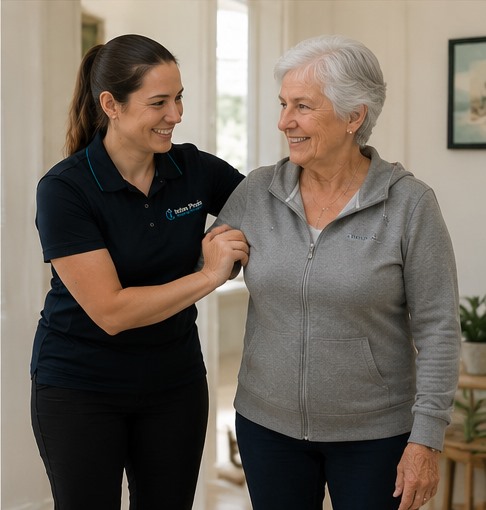
Clinician appointments are essential for assessment, clinical decisions and program changes. Progress also depends on having enough opportunity to practise the right activities between those reviews.
An Allied Health Assistant can provide structured, cost-effective practice under a clinician's direction. That may mean more repetition in the places where the participant actually walks, transfers, prepares meals or accesses the community.
Regular practice helps new strategies become more familiar.
Skills are practised at home and in the community.
Observations are shared with the supervising clinician.
Every activity stays linked to the therapy plan.
A physiotherapist or occupational therapist first assesses the participant, identifies goals and decides which activities are appropriate to delegate.
The AHA then supports the participant to practise those activities safely and consistently. They record progress and barriers, while the clinician remains responsible for review and any program changes.
What happens in a session depends on the participant's assessed needs, therapy goals and delegated program.
Practising prescribed strength, balance, flexibility or conditioning activities with the documented level of assistance.
Repeating clinician-directed walking, transfer, stairs or mobility-aid practice in familiar environments.
Working through agreed routines such as dressing, kitchen tasks, shower preparation or household activities.
Building confidence with therapeutic activities linked to local access, routines and participation goals.
Making therapist-directed activities easier to repeat consistently between clinician reviews.
Practising the agreed use of prescribed mobility or adaptive equipment after clinician assessment.
Age-appropriate practice connected to therapy goals, routines and participation.
Structured support to build confidence and independence in everyday life.
Delegated programs for people living with stroke, brain injury, cerebral palsy or other neurological conditions.
Mobility, strength and functional practice within the clinician's plan.
Participants working towards greater independence with practical home routines.
Therapeutic practice that supports access, confidence and meaningful participation.
They extend a clinician's work by helping the participant practise an agreed program. Assessment, diagnosis, prescription and clinical decisions stay with the qualified allied health professional.
Clear delegation and review keep every session safe, purposeful and clinically connected.
A physiotherapist or OT assesses goals, function, risks and support needs.
The clinician documents the program, boundaries and activities suitable for delegation.
The participant practises the agreed activities at home or in the community.
The clinician reviews progress and makes clinical changes when required.
A practical way to increase therapy carry-over while keeping clinical responsibilities clear.
Participants have more opportunities to practise therapist-directed activities between clinical appointments.
Strategies are applied in the home and community environments where they are needed.
Delegated sessions can extend the reach of the therapy plan where clinically appropriate.
Session observations and barriers feed back to the supervising clinician for review.
The supervising clinician decides what can be delegated, provides instructions and reviews the participant's response.
The AHA is part of the therapy pathway, not a separate or independent service.
Refine currently accepts NDIS referrals for plan-managed and self-managed participants, subject to available funding, clinical suitability and a service agreement.
Home and community visits are available across selected South East Queensland locations, subject to clinician availability and local capacity.
Clear answers for support coordinators, providers, participants and families.
An AHA supports a participant to practise activities that have been assessed, planned and delegated by a qualified physiotherapist or occupational therapist.
An AHA may be appropriate when the participant needs additional structured repetition of an established program. The clinician still completes assessment, clinical decision-making, program changes and review.
No. AHAs do not independently assess, diagnose, prescribe, change programs or make clinical decisions. They work within clear delegation from the treating clinician.
The participant's physiotherapist or occupational therapist creates the plan, decides which activities can be delegated and provides instructions, boundaries and review requirements.
Depending on the delegated plan, sessions may include exercise, walking, transfers, balance, daily living routines, community participation or use of prescribed equipment.
The AHA records relevant observations and shares progress, barriers or changes with the supervising clinician. The clinician decides whether the program needs to be reviewed.
Referrals may come from support coordinators, providers, clinicians, participants or family members. Our team will confirm whether an assessment or existing therapy plan is required.
Yes. Sessions can be delivered in the participant's home or community where appropriate to the delegated activities, risks and goals.
Refine currently works with plan-managed and self-managed NDIS participants. Funding availability and the most appropriate service pathway are confirmed before sessions begin.
Send us the participant's goals, current therapy information and location. Our team will confirm capacity, clinical suitability and the next step.